

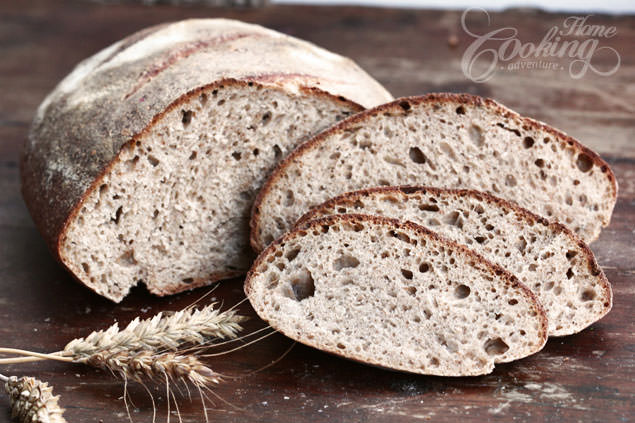
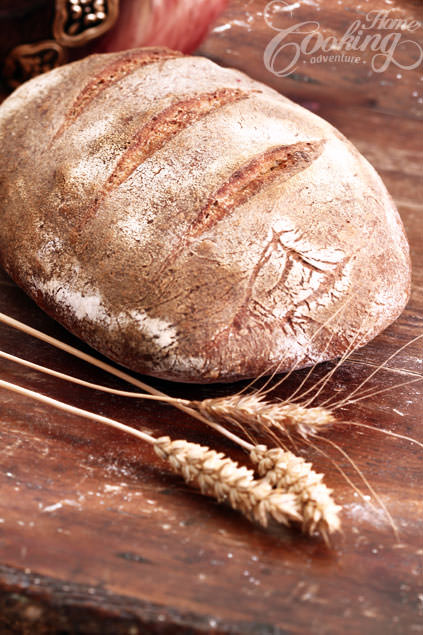
This 50% Whole Wheat Sourdough Bread is a hearty homemade loaf made with equal parts bread flour and whole wheat flour, plus a little wheat bran for extra texture and flavor. It has a crisp, golden crust and a chewy crumb with the deeper flavor you expect from whole wheat bread.
The dough starts with an overnight sourdough starter, then gets a short autolyse, a few rounds of stretching and folding, and a slow final proof. The process takes some time, but most of it is hands-off.
If you enjoy sourdough but want a loaf with more whole wheat flavor than a classic white sourdough, this is a great recipe to try.
Why You’ll Love This Whole Wheat Sourdough Bread
- 50% whole wheat flour – You get plenty of whole wheat flavor without making the loaf too dense.
- Crisp crust and chewy crumb – The high-heat bake and steam help create a beautiful crust.
- Overnight starter – Preparing the starter the night before gives you an easy start the next morning.
- No commercial yeast – The loaf rises naturally with sourdough starter.
- Great everyday bread – Slice it for sandwiches, toast, breakfast, or serve it alongside soups and stews.
What Does 50% Whole Wheat Mean?
The recipe uses equal amounts of bread flour and whole wheat flour in the final dough: 250g of each. This gives the bread a substantial whole wheat flavor while the bread flour helps maintain a lighter, more open crumb.
A small amount of wheat bran is also added to the dough, giving the loaf additional texture and a slightly more rustic character.
How to make whole wheat sourdough bread
Tips for Making Whole Wheat Sourdough Bread
Use an active sourdough starter. Your starter should be healthy and able to ferment the overnight starter properly. A weak starter can result in a slow rise and a dense loaf.
Give the dough enough time. Whole wheat sourdough can take longer to ferment depending on the temperature of your kitchen. Use the appearance and feel of the dough as your guide rather than relying only on the clock.
Don’t skip the autolyse. The 30-minute rest gives the flour time to hydrate before you add the salt and knead the dough.
Watch the dough during fermentation. After the folds, the dough should become smoother and more elastic and show signs of fermentation.
Don’t overproof the final loaf. During the final proof, gently press the dough with your finger. It should slowly spring back rather than immediately filling the indentation.
Create plenty of steam. Steam during the first part of baking helps the loaf expand before the crust sets.
Let the bread cool completely. Resist slicing it while it’s hot. The crumb continues to set as the bread cools, so give it at least two hours before cutting.
Can I Make This Bread With More Whole Wheat Flour?
You can increase the whole wheat flour, but the dough will behave differently and may need adjustments to the water and fermentation time. The 50/50 ratio in this recipe gives you a good balance between whole wheat flavor and a lighter sourdough crumb.
Can I Skip the Wheat Bran?
You can, although the texture and flavor will be slightly different. Since the recipe already contains 50% whole wheat flour, the bread will still have plenty of whole wheat character without the additional bran.
Can I Bake This Sourdough Without a Baking Stone?
Yes. The recipe also gives the option of using a preheated baking sheet. The important part is getting the baking surface thoroughly hot before adding the loaf and creating steam during the first part of baking.
Why Is My Whole Wheat Sourdough Bread Dense?
A dense loaf can be caused by an inactive starter, insufficient fermentation, overproofing, or dough that hasn’t developed enough strength. Whole wheat flour also produces a naturally denser crumb than white flour, so don’t expect exactly the same texture as a loaf made mostly with bread flour.
How Should I Store Whole Wheat Sourdough Bread?
Once completely cooled, keep the bread at room temperature in a bread bag or wrapped in a clean kitchen towel. For longer storage, slice the loaf and freeze it in an airtight bag so you can take out individual slices as needed.
YOU MAY ALSO LIKE:
How to make Sourdough Starter
Easy Sourdough Bread with Flaxseeds
Easy Vermont Sourdough Bread
Basic Sourdough Bread – 1-2-3 Method
Whole Wheat Sourdough Bread
Sourdough Barley Bread
Easy Homemade Bread
Homemade Baguettes
Easy Sourdough Bread
Classic Focaccia
50% Whole Wheat Sourdough Bread – Easy Recipe
Ingredients
Overnight Starter
- 19 g 100% hydration sourdough starter , unfed
- 118 ml water at room temperature
- 94 g bread flour
Final Formula
- 250g bread flour
- 250g whole wheat flour
- 5 tbsp wheat bran
- 310 ml water at room temperature
- 15g salt
- Overnight Starter
Instructions
Prepare the overnight starter.
- To make the overnight starter, in the evening stir down the 100% hydration sourdough starter, and remove 19 g in a bowl. First add the water and stir well. Add flour and stir. Cover with plastic wrap, and let it rest at room temperature for 12-14 hrs (overnight).
- For the 100% hydration sourdough starter – you either make it to have it your own as shown here – or take from a friend who has or buy it from a specialized store)
Prepare the final dough.
- In the morning, in a large bowl mix the flour and wheat bran with water and the overnight starter until well combined. Let the dough rest (autolyse) for 30 minutes.
- Add the salt and knead by hand for 5-8 minutes.
- Wipe the inside of a wide bowl with a little vegetable oil. Place the dough into this wide bowl so the dough can be stretched and folded without removing it from the bowl. Cover with plastic wrap.
- Let the dough ferment at room temperature for 2.5 hours with folds at 50 minutes. The folding is shown here.
- Turn the dough out onto a floured surface. Shape it in form of a loaf. Sprinkle the loaf with flour, cover and let rest for 15 minutes.
- Meanwhile prepare 1 bowl with 1 kitchen towel, sprinkled with flour. Add the dough seam-side-up, cover with the edges of the towel and proof for 2 or 2.5 hours at room temperature. You will know it's done when pressing the dough with the finger the it comes slowly back.
How to bake the sourdough bread.
- Preheat the oven to 475 F (240 C) with baking stone or in case you don't have one preheat a baking sheet. Place a small pot with water at the base of the oven to create steam.
- Turn the proofed loaf onto a parchment and score it. You can see some tips here. Carefully transfer it to the preheated baking stone or back of the baking sheet.
- Bake for 15 minutes with steam then remove the pot with water from the oven and bake for another 20-25 minutes without steam.
- Cool on a wire rack. Let it cool completely before cutting for at least 2 hrs.
Nutrition
Did you make this recipe?
Please let me know how it turned out for you! Leave a comment below and tag @homecookingadventure on Instagram and hashtag it #homecookingadventure.


Your bread looks absolutely amazing. I love the idea of using whole wheat flour in it. It’s just gorgeous.
What a great bread recipe, this looks so delicious! 🙂
Yum! I love sourdough. The fact that this is part whole wheat is even better!
Hi,
I have a question? Should this bread double its size during second rise? I usually bake bread from 2-3 phase sourdough rather than one (they rise slowly and usually they are very sour). My dough rises in proving basket now and it is reaching 2,5 hour time limit. It barely changed the size… Thanks for any tips! Anna
This dough is not very sour probably because I feed the starter 2 days in advance.The bread tastes really good, not too sour but not sweet either.
I wouldn't say it double its size during the second rise. It rises a little bit. I am new to sourdough bread too and to see if it has risen enough I use the finger test by pressing the dough with the finger and if it comes back slowly it means it has proofed enough. If you make this test earlier than 2 hrs you will see how fast the dough comes back that means it's not enough.
I have 100% hydration starter which I made as shown here https://www.wildyeastblog.com/2007/07/13/raising-a-starter/ . I keep it in the fridge and feed it weekly. Every week , no matter if I want to make bread or not I have to feed my starter to maintain it. I do like this: I take 20 g of the starter and add 60 g of water and 60 g of flour. Mix everything together and let it stand on the countertop at room temperature until doubled or tripled in size. After about 12 hours I feed it again. I take another 20 g from the starter and add 40 g of water and 40 g of flour, mix well and let it stand again on the countertop and wait to increase its volume again -this time it rises faster than first time. When it has risen to its maximum level you can put it back to the fridge until next week or if you want to make bread take about 19- 22 g from it (the amount required in the recipe) to make the overnight starter needed for the bread. The rest I put back in the fridge until next week.
Hope my answer helps you. If any other questions let me know, I will try to be as clear as possible.
Great bread. Needed a little bit more water, but great!
Glad it turned good for you:) Depends on the flour I guess, good you handled it out.